For months, AI has been one of the biggest drivers of the stock market. From chipmakers like NVIDIA and AMD to companies building data centres and supplying the infrastructure behind AI, investors have been betting heavily on the sector’s growth.
But the mood on Wall Street is starting to change.
AI-related stocks have come under pressure, with companies across the semiconductor and data centre industries seeing sharp declines. What’s particularly interesting is that even some companies reporting strong earnings are getting caught in the sell-off.
So, what is worrying investors?
According to Ted Mortonson, a technology strategist at Baird, the issue is no longer just about how much money AI companies can make. Investors are increasingly concerned about how these companies are financing their growth, how much debt they are taking on, and whether the returns will justify the enormous spending.
In other words, the AI opportunity may still be growing, but investors are becoming more selective about who they are willing to bet on.
1. Why Is Wall Street Getting Tired of the AI Trade?
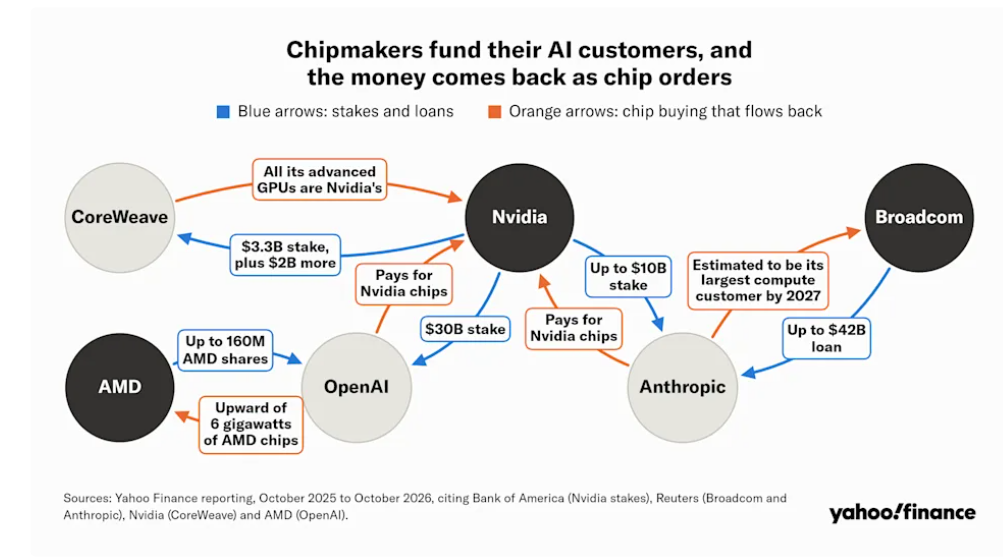
Mortonson made a striking observation about the market’s growing dependence on major chipmakers, saying investors are tiring of the “Bank of Nvidia, the Bank of AMD and the Bank of Broadcom.”
What does that mean?
Companies involved in AI infrastructure need enormous amounts of computing power. That means buying advanced chips, building data centres and expanding computing capacity. Chipmakers such as NVIDIA, AMD and Broadcom have benefited from this demand.
But the AI ecosystem is becoming increasingly interconnected, with financing playing a major role in its expansion.
When companies need significant external funding to continue investing in AI infrastructure, their ability to grow depends not only on demand for AI but also on access to affordable capital.
That creates a potential problem.
If borrowing becomes more expensive or investors become less willing to provide funding, companies may have to reconsider their spending plans. This could affect businesses building data centres, companies purchasing AI chips and, eventually, the chipmakers supplying them.
Investors are beginning to question how sustainable this cycle of spending and financing will be.
2. The Bigger Concern Is the Cost of Building AI Infrastructure
AI requires substantial investment before companies can fully realise the returns.
Building data centres involves spending on land, facilities, electricity, cooling systems, networking equipment and expensive computing hardware. Companies must make these investments while managing operating costs and servicing any debt they have taken on.
The challenge is that spending happens upfront, while the financial benefits may take longer to materialise.
This is where the cost of capital becomes important.
When interest rates and borrowing costs are relatively low, companies can finance expansion more cheaply. But when financing becomes expensive, debt-heavy businesses face a tougher environment.
Higher interest expenses can eat into profits and make ambitious expansion plans harder to justify.
Mortonson specifically highlighted elevated financing costs and concerns about companies with weak free cash flow.
Free cash flow is particularly important here because it shows how much cash a company has left after covering its operating expenses and capital expenditure.
A company can report strong revenue growth and still struggle to generate enough cash to fund its expansion.
That distinction is becoming increasingly important for investors evaluating the AI sector.
3. Why CoreWeave, Oracle and Other AI Infrastructure Companies Are Under Pressure
The recent sell-off has brought attention to companies that are heavily dependent on financing to expand their AI businesses.
CoreWeave, a provider of cloud computing infrastructure for AI workloads, has faced significant selling pressure. Its shares fell more than 15% on Wednesday, October 14, according to the report, amid concerns about borrowing costs and its debt-heavy balance sheet.
Oracle and Nebius have also come under scrutiny as investors assess the financing requirements of companies participating in the AI infrastructure boom.
These businesses operate in a market where demand for computing capacity can be substantial, but meeting that demand requires considerable investment.
The central question is whether future cash generation will be sufficient to support the cost of expansion and financing.
Consider what happens when borrowing becomes more expensive:
- Higher interest expenses: Companies may need to devote more cash to servicing their debt.
- Greater pressure on cash flow: Large infrastructure investments can leave less cash available for other needs.
- More scrutiny of expansion plans: Investors may question whether every planned data centre or infrastructure project will deliver attractive returns.
- Greater sensitivity to market sentiment: Companies that depend on external financing can be particularly vulnerable when lenders and investors become cautious.
This does not automatically mean these businesses will fail. It does mean that their financial position and funding requirements are becoming a bigger part of the investment conversation.
A company with strong demand but heavy financing needs can face a very different set of risks from a company that generates substantial cash internally.
That is the distinction the market is increasingly trying to price in.
4. What Is Circular Financing, and Why Are Investors Worried About It?
Another concern raised by Mortonson was what he described as increased scrutiny of circular financing.
The term refers to arrangements in which money moves between connected companies within the same business ecosystem, potentially making the underlying demand and financial relationships more difficult to assess.
In the AI industry, companies can have overlapping commercial relationships involving investments, cloud computing services, infrastructure commitments and purchases of computing hardware.
For example, one company might invest in an AI developer, which then spends money on computing services supplied by another company in the same ecosystem.
These arrangements can have legitimate business purposes. Investments can help companies secure computing capacity, while long-term contracts can provide suppliers with greater visibility into future demand.
The concern arises when investors struggle to determine how much of the ecosystem’s growth is supported by independent customer demand and how much depends on financing and commitments between connected parties.
If a company’s growth depends heavily on continued funding or spending by its business partners, a change in financing conditions could affect several companies at once.
That is why investors are paying closer attention to the quality of revenue, the sustainability of customer commitments and the cash actually generated by these businesses.
The key question is not simply whether money is flowing through the AI ecosystem. It is whether that spending ultimately produces sustainable economic returns.
5. Strong Earnings Are No Longer Enough to Lift Every AI Stock
Perhaps the most interesting part of the current sell-off is that even companies reporting strong results have struggled to escape the pressure.
Mortonson pointed to companies including Samsung, Micron and ASML, noting that portfolio managers were selling stocks despite strong reported numbers.
This highlights a change in what investors are focusing on.
During a strong growth phase, investors may be willing to pay higher valuations for companies expected to benefit from rising demand. Strong earnings can reinforce confidence in that growth story.
But when expectations become elevated, even good results may not be enough.
Investors start asking additional questions:
- Is the company’s growth sustainable?
- How much of its future performance is already reflected in its share price?
- Can it maintain profitability if financing costs rise?
- Will demand remain strong enough to justify continued investment?
- Are competitive pressures likely to affect future margins?
These questions matter because stock prices reflect expectations about the future, not just the results a company has already delivered.
A business can report record profits and still see its stock fall if investors believe future growth will be slower or the risks are greater than previously expected.
This is an important distinction for anyone following the semiconductor sector.
Good earnings and a rising share price do not always go together, particularly when valuations and expectations are already high.
6. Inflation Could Make the Situation More Difficult
The pressure on AI stocks is not coming from financing concerns alone.
The report also points to hotter-than-expected US wholesale inflation data, which has raised concerns about the outlook for interest rates.
Higher inflation can complicate the Federal Reserve’s decisions. If price pressures remain persistent, borrowing costs may stay elevated for longer than investors expect.
That matters for companies that need substantial amounts of external capital to finance their growth.
When borrowing costs rise, the financial burden on debt-heavy companies can increase. At the same time, investors may become less willing to pay high valuations for businesses whose profits are expected to arrive further in the future.
This combination can put pressure on both company finances and stock prices.
The latest developments also show how different risks can reinforce one another.
- Persistent inflation can keep financing costs elevated.
- Expensive financing can put pressure on companies building AI infrastructure.
- Concerns about infrastructure spending can affect expectations for chip demand.
- Lower growth expectations can trigger further selling across the technology sector.
That does not mean every AI company faces the same degree of risk.
Businesses with strong balance sheets, sustainable cash generation and pricing power may be better positioned to handle a challenging financing environment than those relying heavily on borrowing.
For investors, the important question is how exposed each company is to these pressures.
7. Why Are Investors Selling Semiconductor Stocks Across the Board?
The recent decline has extended beyond companies with heavy debt or significant financing requirements.
NVIDIA, AMD, Broadcom, Micron, Samsung Electronics, SK Hynix and ASML have all faced selling pressure during the broader market downturn described in the report.
Even Taiwan Semiconductor Manufacturing Company, or TSMC, came under pressure despite reporting strong quarterly results.
This suggests that the market is dealing with more than one concern at the same time.
First, investors are reassessing the financing required to sustain the AI infrastructure boom.
Second, elevated valuations mean expectations for future growth are already high for many semiconductor companies.
Third, competition from China is raising questions about the future profitability of some parts of the chip industry, particularly memory semiconductors.
Finally, broader concerns about inflation and interest rates are making investors more cautious about risk.
When several uncertainties emerge together, investors may reduce exposure to an entire sector rather than wait to determine which companies will be most affected.
That can create a situation where fundamentally different businesses experience similar short-term selling pressure.
However, a broad sell-off does not establish that all semiconductor companies have the same financial risks or that their long-term growth prospects have changed equally.
It makes company-level analysis even more important.
8. Is This a Buying Opportunity or a Warning Sign?
This is the question many investors are asking as semiconductor stocks pull back.
The PHLX Semiconductor Index had risen approximately 87% for the year as of October 6, according to the report. By Wednesday’s close, its year-to-date gain had fallen to around 65%.
Even after that decline, the index remained substantially higher for the year.
That context matters.
When a sector has already delivered strong returns, a correction can reflect investors taking profits, reassessing valuations or reducing exposure to positions that have become crowded.
Mortonson described the pullback as healthy, while also noting that institutional investors appeared to be moving away from AI infrastructure stocks and towards software. He added that some investors were leaving technology altogether as they sought to lock in gains ahead of year-end.
So, does that make the current decline a buying opportunity?
There is no universal answer.
For investors who believe AI demand will continue growing over the long term, falling share prices may create opportunities to reassess companies at more attractive valuations.
But a lower share price alone does not make a stock cheap.
Before considering an investment, it is worth examining:
- Valuation: Has the stock become reasonably priced relative to its expected growth?
- Balance sheet: Does the company have manageable debt and sufficient financial flexibility?
- Cash flow: Can it fund a meaningful portion of its expansion through internally generated cash?
- Earnings outlook: Are future revenue and profit expectations supported by credible demand?
- Competitive position: Can the company maintain its market share and profitability as competition increases?
Investors also need to distinguish between a temporary decline in sentiment and a genuine deterioration in a company’s business outlook.
If a stock falls because investors are taking profits after a strong rally, the long-term investment case may remain intact.
If it falls because its growth expectations are becoming harder to achieve or its financing model is proving unsustainable, the risks may be more significant.
The challenge is figuring out which situation applies to each company.
9. Could Money Move From AI Infrastructure to Software?
Another important observation from Mortonson was that institutional investors may be shifting some money towards software.
For much of the AI rally, semiconductor companies and infrastructure providers have been among the most visible beneficiaries of growing investment in computing capacity.
But investors may now be looking for other ways to participate in AI adoption.
Software companies could benefit as businesses integrate AI into their existing products, automate workflows and develop new services.
The distinction is that infrastructure providers must often commit substantial capital to build and maintain computing capacity, while software businesses may have different cost structures and revenue models.
That does not mean software companies are automatically safer investments. Their valuations, profitability and ability to turn AI adoption into sustainable revenue still matter.
Nor does a possible shift towards software mean that demand for AI chips is disappearing.
It may simply reflect a change in where investors believe the most attractive risk-adjusted returns can be found.
The broader takeaway is that the AI investment opportunity is not limited to chipmakers or data centre operators. As the technology develops, investors may reassess which parts of the value chain are best positioned to capture its economic benefits.
10. What Should Investors Watch Next?
The coming weeks could offer important clues about whether the sell-off is primarily a correction in sentiment or a sign of deeper concerns about AI spending.
Here are five developments worth watching.
1. Corporate earnings and guidance
Quarterly results will help investors assess whether demand for AI infrastructure remains strong and whether companies are translating that demand into revenue and profits.
Forward guidance will be particularly important because markets are focused on what comes next.
2. Free cash flow and capital expenditure
Investors should pay attention to how much companies are spending to expand their AI businesses and how much cash they retain after those investments.
Strong revenue growth is encouraging, but the ability to fund expansion sustainably also matters.
3. Borrowing costs and balance sheets
Companies with significant financing requirements may face greater pressure if debt becomes more expensive.
Credit-market developments could therefore provide useful signals about the financial health of AI infrastructure businesses.
4. Inflation and Federal Reserve policy
Further inflation data could influence expectations for interest rates.
A prolonged period of elevated borrowing costs would be particularly relevant for companies that depend on external financing to expand.
5. Evidence of sustainable AI demand
Ultimately, investors need to see that spending on AI infrastructure is generating economic value.
Customer demand, revenue growth, profitability and returns on investment will help determine whether the current pace of expansion can be sustained.
These factors will not necessarily move in the same direction. A company could report strong demand while facing pressure on margins, or deliver impressive earnings while requiring substantial additional capital expenditure.
That is why looking at a single metric is unlikely to tell the whole story.
The Bigger Picture: AI Is Still a Major Opportunity, but the Market Is Asking Harder Questions
The recent sell-off is a reminder that a promising technology and an attractive stock investment are not always the same thing.
AI has created substantial opportunities for semiconductor manufacturers, cloud computing providers and companies building the infrastructure needed to run advanced models.
But the scale of the investment also creates financial risks.
As spending increases, investors need to understand who is funding that expansion, how much debt is involved, whether companies are generating sufficient cash and how quickly the investments are expected to pay off.
The market is now paying closer attention to those questions.
That does not automatically mean the AI boom is ending. It does suggest that investors may become more selective about which companies they are willing to reward with high valuations.
Companies with strong financial positions and sustainable business models could continue to benefit from AI adoption. Businesses that rely heavily on expensive financing or struggle to convert growth into cash may face greater scrutiny.
For investors, this could be a period to look beyond the excitement surrounding AI and examine the financial fundamentals behind the story.
The real question is no longer just how big AI could become. It is which companies can turn that growth into lasting profits and sustainable cash flow.
Let’s Discuss
The recent sell-off has created an interesting debate. AI demand remains a major theme, but concerns about debt, valuations and financing costs are changing how investors look at the sector.
What do you think is driving the current decline in AI stocks?
Is this a healthy correction after a massive rally, or is Wall Street starting to question whether the AI infrastructure boom can deliver the returns investors expect?
And if you were looking at the sector today, would you focus on chipmakers, AI infrastructure companies or software businesses?