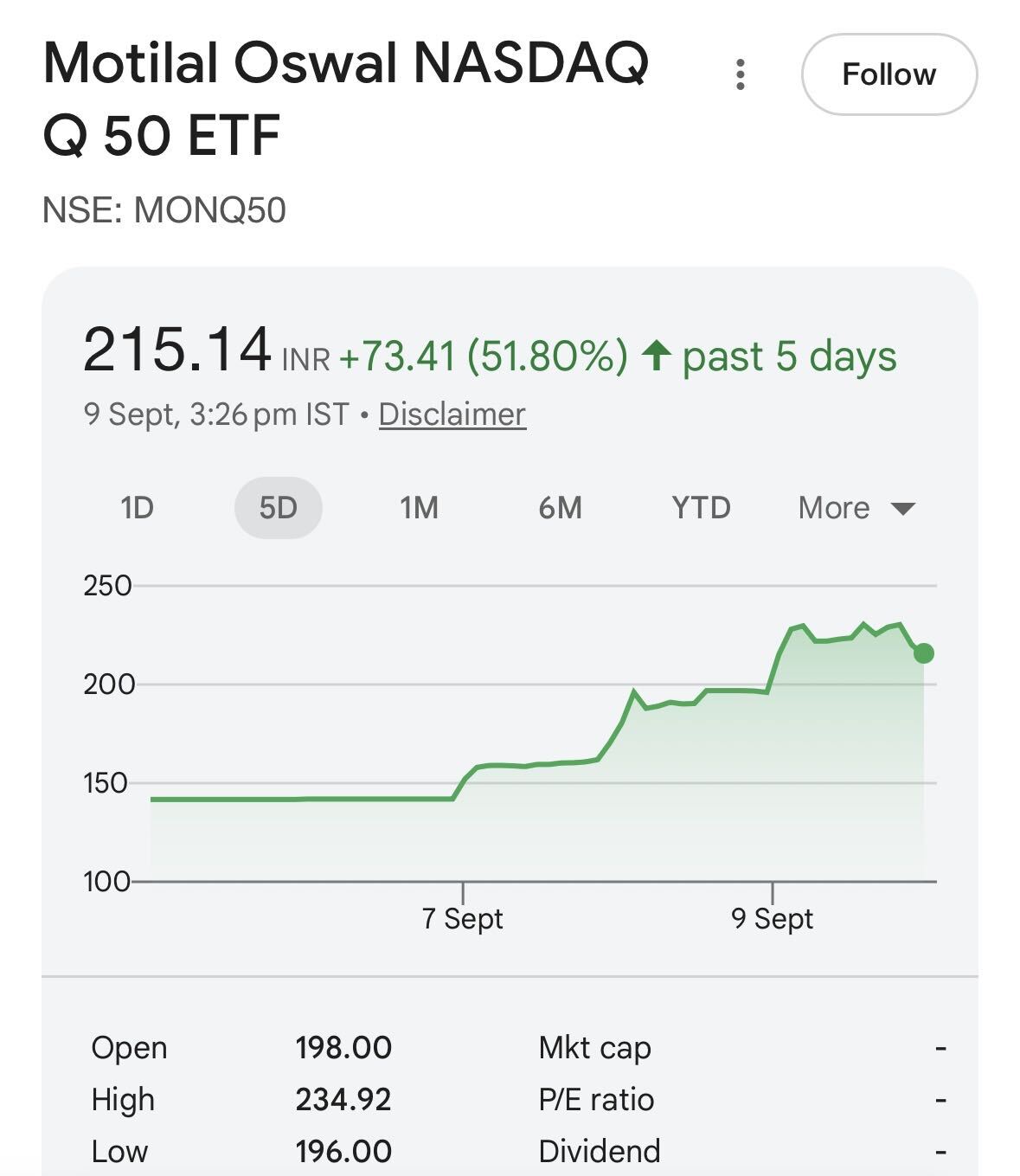
An ETF in India went up 51.8% in a week, while the index it’s supposed to track barely moved at all.
The Motilal Oswal Nasdaq Q50 ETF was sitting around ₹144 for most of last week, and by 9 September it had touched ₹234.92, a jump the underlying Nasdaq Q50 index came nowhere close to matching.
That gap between the two is really the story here.
SEBI limits how much Indian mutual funds can invest overseas, with one cap for the industry as a whole and a smaller one specifically for ETFs. Once an AMC uses up its share of that limit, it simply can’t create new ETF units anymore, so supply stops even though people still want to buy in.
And when demand keeps coming but supply doesn’t, the price on the exchange starts trading well above what the fund is actually worth. That difference is the premium, and it means anyone buying in a moment like this isn’t really paying for more of the index, they’re paying to skip a queue that has nothing to do with performance.
This particular ETF has been here before too. Motilal Oswal froze new unit creation on it back in 2022 for this exact reason, so the pattern tends to repeat whenever demand runs ahead of the limit.
The part worth remembering is that premiums don’t last. They tend to come back down toward the NAV over time, often while the index itself is doing perfectly fine, which means the loss isn’t from the index falling but from having paid too much to begin with.
The simplest way to avoid this is to check the ETF’s exchange price against its NAV before buying, especially for anything tracking a foreign index. If the gap is wide, that’s the real cost you’re taking on.
GlobEd has a section that walks through exactly this, how SEBI’s overseas investment limits work and why they keep resurfacing.
Read for free on GlobEd: Check SEBI Limits on Overseas Investment by Mutual Funds